



Saturn-Neptune conjunction as a turning point: the astrological alignments of March 2026, anchored by the rare Saturn-Neptune conjunction, coincide with a period of geopolitical turmoil unprecedented in recent decades. These planetary configurations of March 8, 2026, are major turning points in modern history — and they are worth examining carefully, especially now that events on the ground are validating them.
This analysis is based on personal astrological research from 2022, independent of the dominant currents in mundane astrology. I return to them now because they provide a more useful prism for understanding the crisis in Iran.
The Saturn-Neptune conjunction remains the dominant influence of early 2026. The alignment occurs in the first degrees of Aries: Saturn at 2°22′, Neptune at 1°14′. This fusion of energies represents the collision of rigid structures (Saturn) and the dissolution of boundaries (Neptune) — all in the most impulsive and combative sign of the zodiac.
Geopolitical Premises: January – February 2026
To understand the present and how different countries like the UAE, the US, and the UK will be affected, we need to look at the events that precipitated the current crisis in Iran (and the Middle East).
Operation Venezuela: In early 2026, the US conducted a special covert operation that resulted in the capture of President Nicolás Maduro — a shock to international public opinion, but the kind of initiative perfectly calibrated to the energy of Aries and Pisces. (Aries for the bold unilateral strike, Pisces for the covert execution). Maduro’s hearing is scheduled for March 17, just before the spring equinox, with Mars transiting Pisces — a placement associated with covert actions, covert operations, and tensions that build invisibly before erupting.
Escalation in the Persian Gulf: On February 28, following the failure of nuclear negotiations, the US-Israeli coalition struck Iran. The death of Ayatollah Khamenei and several of his successors created a power vacuum with consequences that are difficult to predict.
Iranian retaliation: Since March 2, Iran has launched hundreds of ballistic missiles and drones at nine countries, massively disrupting maritime traffic through the Strait of Hormuz. Hundreds of cargo ships and oil tankers are anchored, waiting.
These three events were not anticipated by conventional analysts. But they correspond to recurring astrological themes: Aries as a sign of action and aggression, of military surprise, of absolute status quo.
Why Now, astrologically speaking?
The current situation involves a complex web of tensions between the UAE, the US, Iran, and the UK. If Saturn-Neptune is the “charge”, Uranus acts as the detonator.
Why is Uranus critical?
The conjunction occurs in Aries—a sign ruled by Mars, the sign of the pioneer and the warrior, where the Sun is exalted. This means that global tensions are forcing nations into polarized alliances. The Sun is uniting—but in this configuration, it is uniting for conflict, not cooperation. With Uranus stationary in the coming days, astrological theory anticipates a sudden and irreversible shift in global power dynamics.
Countries’ astrological maps: 7-8th March 2026
On March 8, 2026, at 01:15 GMT, a Venus-Saturn conjunction simultaneously activates several national charts: UAE, USA, and UK.
Venus affected: USA, UK, UAE, and Iran all have natal Venus positions stressed by this transit. Venus rules diplomacy, currency, and public image of nations.
Economic reassessment: We are witnessing a forced pivot towards the energy-heavy sector (fossil fuels). The Mercosur agreement announced by Ursula von der Leyen on February 27 has already triggered a total reassessment of European agricultural and energy investments.
USA: A „Pearl Harbor” moment
The most alarming transit for the United States is Uranus in the station while aspecting Pluto in the 2nd House. This specific astrological configuration has not appeared since the attack on Pearl Harbor. Then, it preceded a retaliation of historic proportions; today, it suggests a profound transformation of American financial and military hegemony. Not necessarily a fall — but a forced metamorphosis.
This Uranus stationing configuration is valid until March 8, 2026, 10:00 AM (GMT).
Great Britain: A systemic vulnerability
The natal chart of the United Kingdom shows considerable pressure during this period:
- The natal Moon is affected by the triple conjunction Saturn-Venus-Neptune, at a close degree.
- The South Node is conjunct Jupiter in the 6th House, while a Saturn-Mercury Cazimi opposition activates the same house.
- Mars is conjunct natal Pluto in the 11th House — a classic indicator of institutional or infrastructural crises.
The likely nature of the disruption is not necessarily direct military, but rather a hit to critical infrastructure: IT networks, energy, or transport networks. Emergency services could be affected by overload or operational incapacity — a consequence of the simultaneous impact of the planets Saturn and Jupiter.
UAE: “Critical” window
The United Arab Emirates occupies a paradoxical position in this configuration: a strategic ally of the US that has gradually become an Achilles heel of the Middle East. Since the US became a net oil exporter — a transformation that was consolidated after 2019 — energy dependence on the Gulf has disappeared from Washington’s calculations. The UAE is no longer a vital priority, but a negotiable partner. It is precisely this vulnerability — of being expendable — that the March 7 transits activate in the UAE’s natal chart.
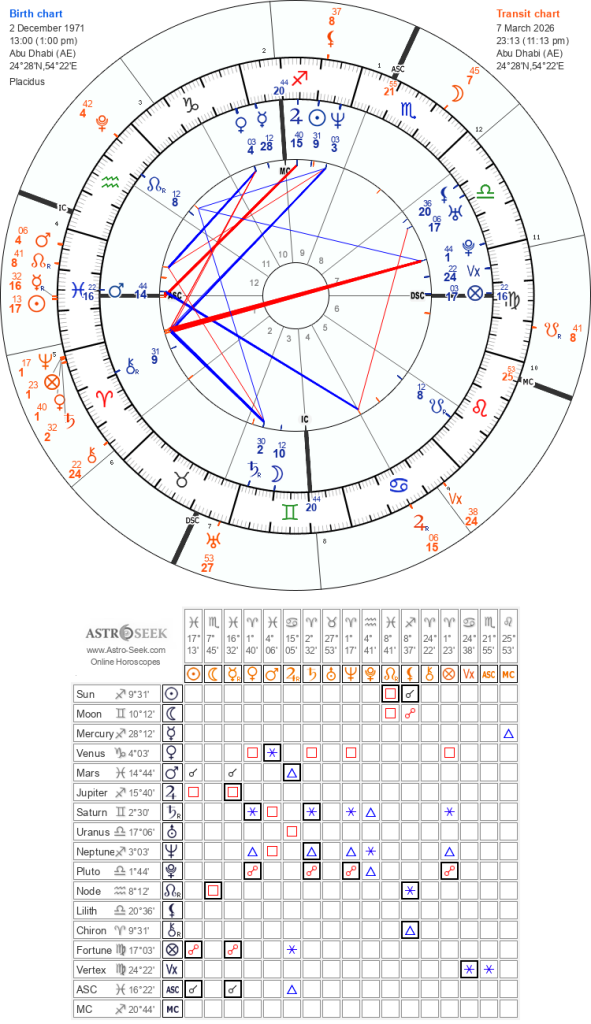
On March 7, 2026, between 1:30 PM and 8:13 PM GMT, Venus joined Neptune in Aries.
For the UAE, this moment is amplified by Pluto at 4° Aquarius, forming a trine to natal Pluto in the 7th House, along with a Neptune-Neptune trine. This alignment favors the extreme idealization of a new partnership — a rare moment of geopolitical synchronicity.
Pax Arabica or Protectorate?
In 1959, the US solidified its military and diplomatic presence in the Middle East through the Eisenhower Doctrine, security agreements with Saudi Arabia, and control of regional oil extraction. It was at this point that Washington became the explicit guarantor of Gulf stability — in exchange for access to oil. Today, in 2026, that cycle is reversing.
The paradox is that the reversal is occurring precisely at the moment when the US no longer needs that oil. The US has built a world order in the Gulf to secure its energy. It has won energy independence. And it is precisely this victory that frees it from the obligation to defend what it has built. The guarantor is leaving just as the edifice is collapsing.
For the UAE and the Gulf states, this paradox means that they are waking up in a security architecture built for a world that no longer exists — with US military bases whose commitment is becoming negotiable, with economies tied to a dollar that is undergoing its own metamorphosis, and with no confirmed replacement.
China can take on the role of guarantor — but Pax Sinica in the Gulf would be fundamentally different from the Pax Americana of the past: without liberal values, without NATO as a backer, without Western legal mechanisms. A pragmatic, cold, transactional protectorate — an arrangement that, paradoxically, would also suit Washington. Trump does not want to manage the Gulf, but only to control the outcome: who leads post-Khamenei Iran and on what terms.
This is, in essence, the energy of Saturn-Neptune in Aries: old structures are dissolving, and what replaces them is not yet visible. A new order is born — not by consensus, but by vacuum.
This is not the first time that Saturn-Neptune has marked the end of a world. The last conjunction, in 1989, coincided with the dissolution of the Soviet bloc and the collapse of the USSR — another world order that seemed unshakable.
The difference from 1989: then, there was already a visible replacement. Now, there is not.

