


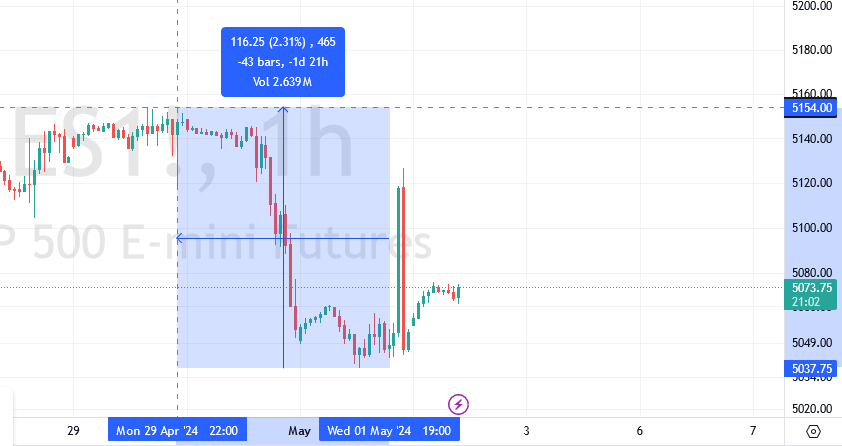
US capital market indexes have resumed their downtrend from their yearly and multi annual highs. The S&P500 index initially fell by almost 2.3 percent. US markets awaited the US interest rate decision and Jerome Powell’s FOMC statement following the Federal Reserve’s rate decision. Investors also closely monitored the most anticipated interview after the FOMC statement for potential clues on future interest rate decisions.
Capital Market Overview
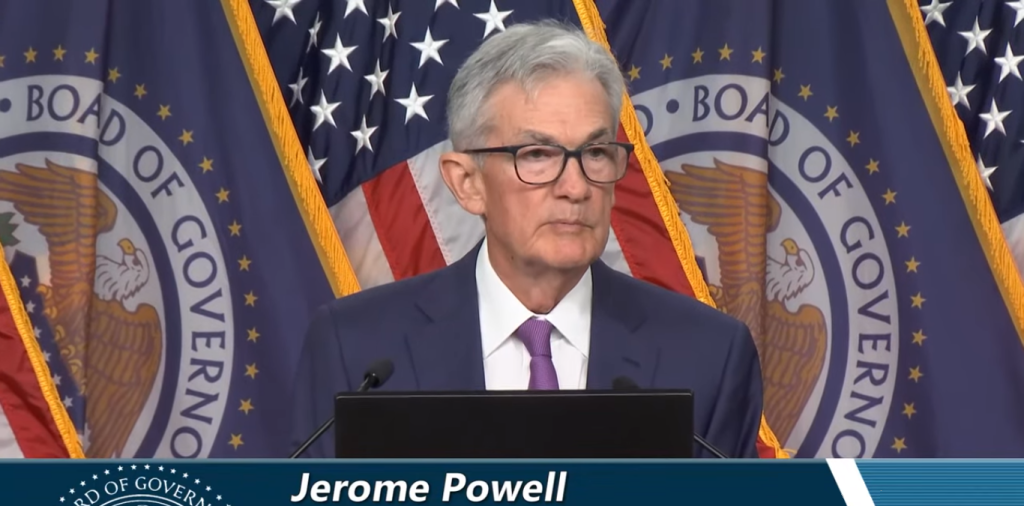
US capital market indices have resumed their downtrend from their yearly and multiannual peaks.
On May 1, the S&P500 initially fell by almost 2.3 percent.
However, the benchmark index recovered on Jerome Powell’s comments during his FOMC statement and subsequent interview.
The US markets awaited a pivotal event: the US rate decision, followed by a statement and an interview with US Federal Reserve Chairman Jerome Powell. These events carry significant weight for the US capital market and economic trends, keeping market participants highly engaged and informed.
The federal funds rates remained unchanged at 5.5%, as anticipated. However, the context makes this decision particularly intriguing: just a few days prior (April 25, 2024), the Advance GDP (quarter-over-quarter) figures were a surprising deviation from expectations. Analysts were projecting around 2.5%, but the actual numbers were significantly lower, at 1.6%.
Bloomberg TV host Michael McKee expressed surprise at these unexpected figures, highlighting the market’s confusion over the disappointing economic data.
GDP comes in as a surprise. This one is for the “bears,” guys, 1.6%. That is about half of the 3.4% that we saw in the fourth quarter. It is also significantly lower than the anticipated 2.5%. We need to, at this point, look at what the issue was with that. Personal consumption, 2.5%, that’s lower than the 3% that was anticipated.
And so that, maybe, something that we need to look into: what happened with consumer spending, because it had appeared very strong?
The quarterly price index is 3.1% for the headline. That is up from 1.6%. It is a tick higher than the 3% that was forecast.
And CORE (Core CPI) is at 3.7% on a year-over-year basis, up from 2%. So that is higher than the 3.4% by a significant margin, 3.4% that was anticipated.
So, at this point, what we’ve got is a series of data points that say, no, the Fed does not need to be cutting rates at this point.
Michael McKee (Bloomberg) – April 25, 2024
Fundamental Analysis
The current economic environment differs substantially from the pre-2007-2009 financial crisis period.
This statement implies that the current economic conditions and market dynamics are fundamentally different from the pre-crisis era. However, the investments shifted to more innovative sectors (growth stocks), especially in post-pandemic months.
A decrease in GDP can have a deflationary effect, potentially reducing the general price level of goods and services in an economy. This deflationary impact, coupled with the evolving dynamics of the FOMC statement and Jerome Powell’s commentary, underscores the critical need for investors to reassess their market strategies.
Markets are likely to continue their downward trajectory, exerting pressure on various sectors, including credit markets, as well as causing supply chain disruptions and potentially necessitating future aid for countries at war if the negative trends persist.
The Federal Reserve’s capacity to provide substantial funding in the near term is also limited, necessitating that market participants prepare for potential shifts in the market.
Key Economic Indicators and Timeline
The recent GDP figures have significantly reshaped the market landscape. This reshaping will be evident on May 30 with the Preliminary GDP number and later on June 27, 2024, with the Final GDP number, which provides a precise measure of economic growth. The next FOMC rate decision, scheduled for June 12, 2024, also carries significant weight, underscoring the urgency and importance of these upcoming events.
Is the market Volatility Index (VIX) hinting at an all-time high in markets?
The days following the FOMC decision generally favored future stock growth. The Volatility Index resumed its downward trajectory from May 1, 2024, with a sudden 12% increase, sparking a brief period of panic among investors.
As a result, the XLK index (SPDR Select Sector Fund – Technology) climbed higher. Additionally, the XLF (SPDR Select Sector Fund – Financial) (approximately 2.8% higher) while the VIX index decreased. The healthcare sector (XLV index) grew only 1.21% in a week, facing some challenges, including an eventual RFK drop-out and an alliance with Donald Trump.
🌱 Support independent research and analysis on market opportunities!
💛 Morraevo is an independent, self-funded project. If you value this work, consider supporting it!
If you liked this you might also like Why I’ve Sold Teraplast stock?

⚠️ Disclaimer
This article isn’t trading advice, and any financial loss associated with it is solely your responsibility.
However, a more cautious investment approach can generate stability and profit in the long run.
Refined Elliott Wave patterns are complex to identify, and there is always room for error. I don’t recommend using them, especially if you are a beginner in investing. Always seek professional financial advice when investing. Thank you!
News sources and data:
Bloomberg Television: US Economic Growth Slows to 1.6%, Below All Forecasts (video)
Federal Reserve Monetary Policy (May 1, 2024) (PDF format)
